There has never been a better time to build your own therapy practice in Canada. Demand for mental health services is at an all-time high, the stigma around seeking help is finally breaking down, and the tools available to independent practitioners today are more powerful — and more accessible — than at any point in history.
Yet the number one reason talented therapists, counsellors, and psychologists stay stuck in salaried roles isn’t confidence in their clinical skills. It’s the fear of the business side: How do I register? What do I charge? How do I get clients? What software do I need? How do I stay compliant?
This guide answers all of it. Whether you’re a newly registered psychotherapist, a seasoned counsellor ready to go independent, or a social worker exploring how to start a private practice in Canada for the first time — you’ll find a clear, Canada-specific roadmap here, including the tools and platforms that make launching significantly faster and less stressful than going it alone.
Step 1: Confirm Your Licensing & Registration Requirements by Province
Before anything else: your credential determines everything about how you can practise, market your services, and bill clients. Canada has no single national mental health licensing body. Each province regulates practitioners differently, and these distinctions directly affect whether your clients can claim your sessions on extended health insurance — which is often the deciding factor in whether someone books with you at all.
Key registration bodies by credential:
- Ontario — Registered Psychotherapists (RP) → CRPO; Social Workers → OCSWSSW; Psychologists → College of Psychologists of Ontario
- British Columbia — Registered Clinical Counsellors (RCC) → BCACC; Registered Social Workers → BC College of Social Workers
- Alberta — Registered Psychologists → College of Alberta Psychologists; counsellors are currently unregulated — a critical distinction for insurance billing
- Quebec — Psychologists → Order of psychologists of Quebec; all client communications must be bilingual
- Atlantic provinces — Regulation varies; check with your provincial counselling association for current requirements
Your registration status also determines your GST/HST obligations. Regulated health practitioners in most provinces are GST/HST exempt — counsellors in unregulated provinces may not be. Speak to a CPA who works with health professionals before you register your business.
| Quick win: Even in unregulated provinces, joining the CCPA or CASW boosts client trust, satisfies many insurer requirements, and typically includes professional liability insurance in the membership fee. |
Step 2: Register Your Practice as a Business in Canada
Once your credentials are confirmed, you need a legal business structure. For most practitioners starting a private practice in Canada, the choice comes down to three options:
- Sole Proprietorship — fastest and cheapest to set up ($60–$350 to register). No personal liability protection — your personal assets are exposed if a claim is made against your practice. Best for low-overhead, part-time launches.
- Partnership — suitable if you’re launching with a colleague. Requires a formal agreement covering fee splits, decision-making, and exit provisions. Simple to register; shared liability.
- Professional Corporation (PC) — available to regulated health professionals in most provinces. Provides limited liability and significant tax advantages once annual net income exceeds ~$80,000–$100,000. Higher setup cost but typically pays for itself within two to three years at full caseload.
Register your business name provincially — or federally if you plan to practise across multiple provinces. If you offer services in Quebec, your business name and client-facing materials must comply with the Charter of the French Language.
| Naming tip: Naming your practice after yourself is simple, but it creates complications if you ever want to hire associates or sell. Choose a practice name that’s brand-able and doesn’t depend on your personal identity. |
Step 3: Secure Professional Liability Insurance Before Your First Session
This is the one step you cannot skip or delay. Professional liability insurance (malpractice/errors & omissions coverage) protects you the moment a client makes a complaint or legal claim related to your clinical services. In Canada, leading providers include:
- BMS Group — widely used by CCPA and CASW members; coverage from ~$250/year for solo practitioners
- RSA Canada and Intact Financial — common for registered psychologists
- Provincial association group plans — often the most cost-effective route if you’re already a member
Most policies include clinical liability, legal defence costs, and regulatory complaint coverage. At $250–$600 per year, this is the lowest-cost line item in your entire private practice setup checklist — and easily the most consequential one to have in place.
Step 4: Set Your Fees — What Canadian Therapists Are Charging in 2026
Undercharging is the most common financial mistake practitioners make when starting a counselling practice in Canada. Most new therapists set fees based on what feels “reasonable” rather than what’s sustainable — and end up burning out before their practice ever gains momentum.
Here’s a realistic picture of therapy private practice fees in Canada in 2026:
- Registered Psychotherapists (Ontario): $130–$200 per 50-minute session
- Registered Clinical Counsellors (BC): $140–$200 per session
- Registered Psychologists (national): $200–$300+ per session
- Registered Social Workers (therapy-focused): $120–$180 per session
The formula: add up every monthly fixed cost (rent, software, insurance, association dues, continuing education) and divide by the number of client hours you want to work. The result is your minimum viable fee — not your ceiling. Most urban practitioners price above this once they have a full caseload, because demand justifies it.
Sliding scale spots are a meaningful way to improve access. Limit them to 3–5 clients maximum to protect your financial sustainability — or consider allocating them specifically to clients who would otherwise face real barriers to care.
| Related Reading
• Mental Health Benefits for Employees in Canada: What Employers Must Offer in 2026 • Employee Wellness Programs in Canada: The Complete Guide for 2026 |
Step 5: Choose Your Practice Management Platform — This Decision Shapes Your Entire Day
Here’s what no one tells new practitioners: the technology you choose when you launch is nearly impossible to change once you have 20+ active clients. Migrating client records, consent forms, invoices, and session notes mid-practice is a nightmare. Get this right from day one.
Your platform needs to cover scheduling, clinical notes, secure client messaging, invoicing, and privacy compliance — all in one place, without requiring you to stitch together five different apps.
Most new practitioners spend 8–12 hours every week on administrative tasks when they’re using disconnected tools. That’s the equivalent of 6–8 billable sessions per week — lost, every single week, to admin friction that better practice management for mental health simply eliminates.
| The real cost of cobbling tools together
A separate booking link, a different system for notes, another app for invoices, and a generic video tool that isn’t PIPEDA-compliant — this is how most new practitioners start. It feels cheaper. It isn’t. The admin hours, the compliance gaps, and the unprofessional client experience quietly cost you clients and income every single month. What Wellovis does differently Wellovis was purpose-built for Canadian therapists, counsellors, and wellness professionals. It combines a done-for-you professional website, PIPEDA-compliant booking tools, intake forms, and client management into one platform — so you launch looking polished and stay efficient as you grow. No tech overwhelm. No compliance guesswork. Just your practice, running the way it should from day one. |
Two specific capabilities deserve extra attention as you evaluate platforms:
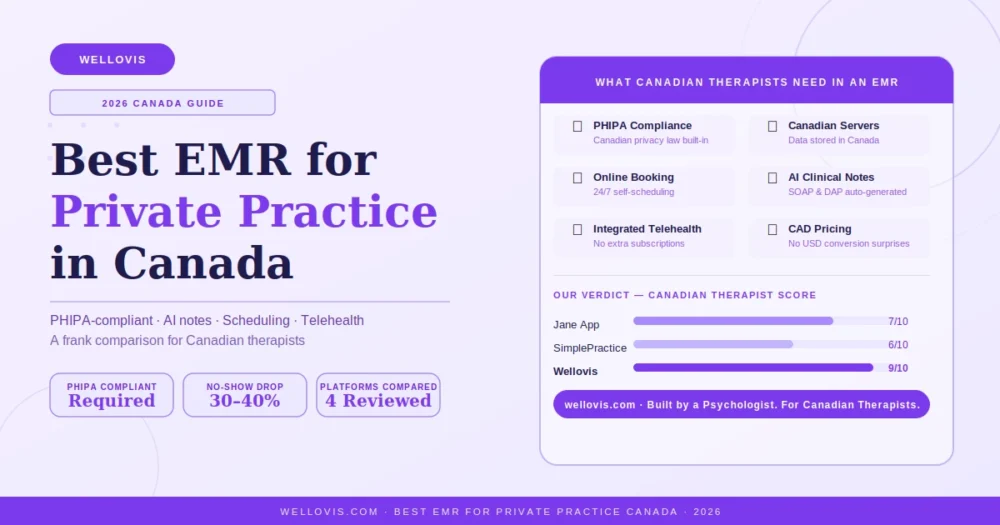
Scheduling & Client Booking: Practices that give clients the ability to self-book through dedicated therapist scheduling software consistently see 30–40% fewer no-shows and significantly higher client retention rates — because booking is frictionless, reminders are automated, and clients feel in control of their own care. Wellovis Connect is built specifically for this: it handles the entire client-facing scheduling experience so you never have to play phone tag to book a session again.
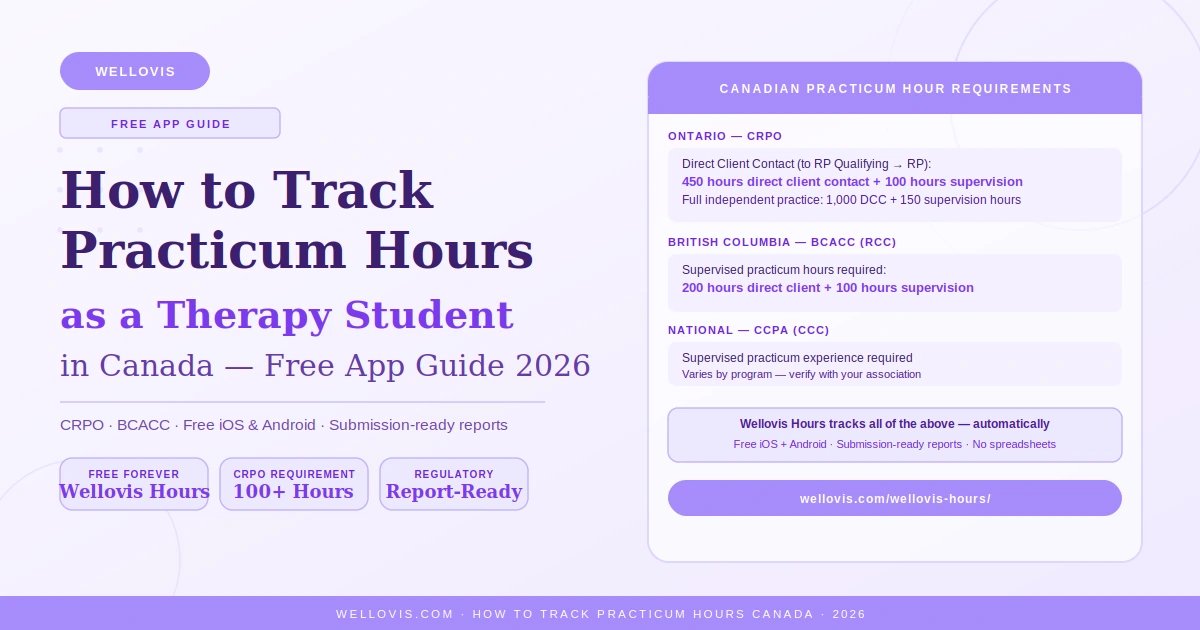
Practicum & Supervision Tracking: If you’re still completing supervised hours — or plan to hire associate therapists and provide supervision yourself — manual hour tracking is a serious liability. Purpose-built therapy student practicum management through Wellovis Hours keeps a precise, timestamped record of every session, competency milestone, and supervisor sign-off, in the format your regulatory body requires. It takes a task that used to consume hours of spreadsheet work and makes it automatic.
| Are you manually tracking practicum hours in a spreadsheet?
Spreadsheets get lost, hours get miscounted, and regulatory submission time becomes a stressful audit of months of handwritten logs. One discrepancy can delay your registration — or put your associates’ hours at risk. Wellovis Hours fixes this completely Wellovis Hours is a dedicated practicum and supervision tracking tool built for Canadian mental health professionals. Every session is logged automatically, competency milestones are tracked in real time, and your records are always submission-ready. Whether you’re the student or the supervisor, the hours add up transparently — no spreadsheets, no gaps, no surprises. → See How Wellovis Hours Works — Track Every Hour Automatically |
Step 6: Set Up Your Professional Website — Your Practice’s 24/7 Front Door
In 2026, a professional website isn’t optional — it’s your most important marketing asset. Most clients will check your website before they ever call or book. A poorly designed, slow, or generic site quietly sends them to a competitor who looks more credible online, even if you’re the better clinician.
What a high-converting therapy website must include:
- A clear headline that speaks to your ideal client’s specific pain, not your credentials
- A professional photo — warmth and approachability matter enormously in mental health
- Service pages for each specialty area (anxiety, trauma, couples therapy, etc.) optimized for local search
- Online booking integration with direct calendar access — no “email me to book” forms
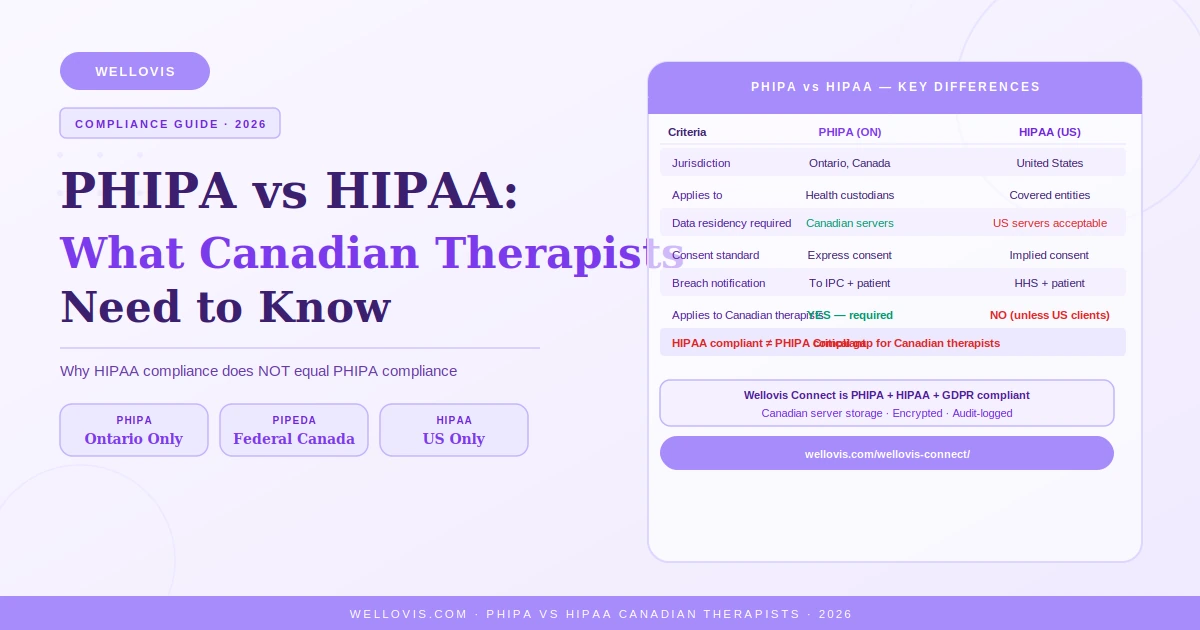
- PIPEDA/PHIPA-compliant intake forms and privacy policy
- A blog that answers the questions your clients are actively searching for online
The challenge most therapists face isn’t knowing what the website needs — it’s having the time, skills, and compliance knowledge to build it properly. Health-focused websites have specific privacy, security, and accessibility requirements that generic website builders and designers often miss entirely.
| Most therapy websites are built by designers who don’t understand health compliance
A beautiful website that stores intake forms on a non-compliant server, uses non-encrypted contact forms, or lacks proper privacy policy language isn’t just a marketing problem — it’s a regulatory and legal exposure. PIPEDA violations can result in fines and regulatory complaints. Wellovis builds done-for-you, compliance-ready therapy websites Wellovis specialises in done-for-you websites specifically for Canadian therapists and wellness professionals. Every site includes PIPEDA-compliant booking and intake tools, SEO-optimized content, mobile-first design, and your professional brand identity — built by people who understand both web design and Canadian health law. You can be fully live and professionally online within days, not months. → Explore Wellovis Website Packages — Launch Your Practice Online |
Step 7: Create Your Client Intake System and Consent Documentation
Before you see your first client, every document in your intake process must be in place — signed, stored securely, and retrievable. Your intake package should include:
- Informed Consent Form: Nature and limitations of therapy, confidentiality and its exceptions (mandatory reporting), fees, cancellation policy, and your therapeutic approach
- Privacy Policy (PIPEDA-compliant): How personal information is collected, stored, used, and under what conditions it may be disclosed
- Intake Questionnaire: Presenting concerns, mental health and medical history, current medications, emergency contact, and insurance information
- Fee Agreement: Session rate, accepted payment methods, late cancellation and no-show fees, direct billing process for extended health benefits
- Telehealth Consent (if applicable): Technology risks, emergency protocols across distance, and jurisdictional considerations for online sessions
| Time saver: Wellovis includes ready-made, province-specific consent and intake templates with every website package — built and reviewed for Canadian compliance requirements so you’re not starting from a blank document or paying a lawyer for something that already exists. |
Step 8: How to Get Clients for Private Practice in Canada — What Actually Works
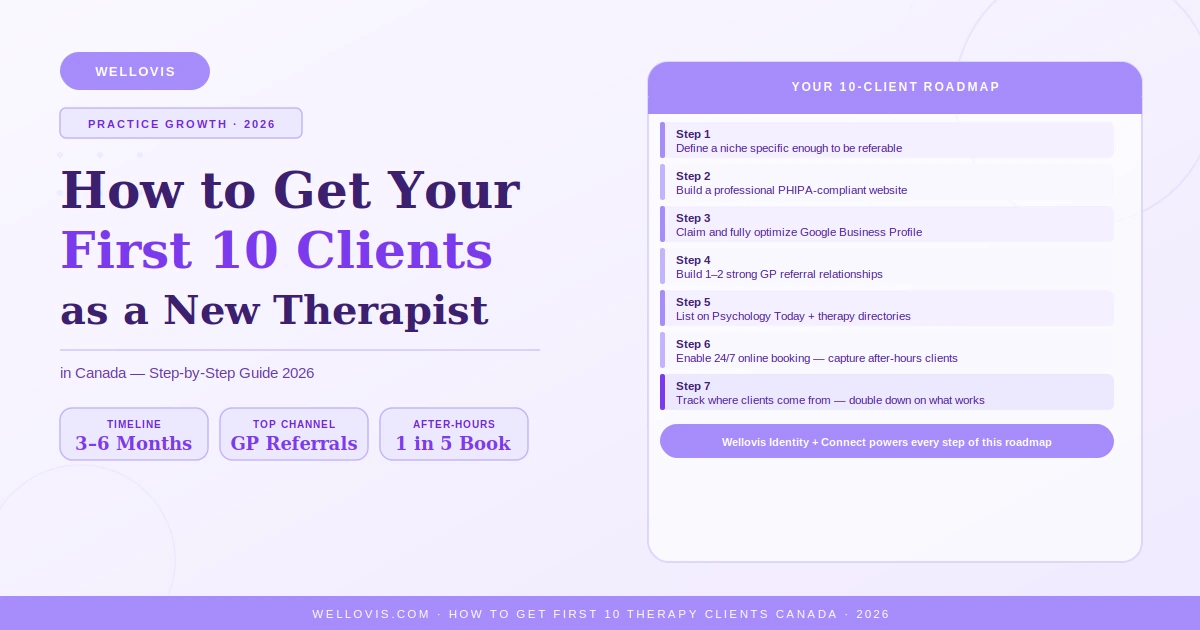
This is the question every new practitioner asks most urgently, and the honest answer surprises most people: your first 10–15 clients will almost certainly not come from Google. They’ll come from relationships. Google becomes your passive, long-term client acquisition engine — but referrals fill your caseload in months, not years.
1. Build a Psychology Today Profile Before Anything Else
Psychology Today Canada is the highest-traffic therapist directory in the country. A profile written in your client’s language — specific about who you help and what their life looks like before and after therapy — generates 2–5 inbound enquiries per month within 60 days for most practitioners in major markets. Write about transformation, not modalities. “I help high-achieving professionals who feel like they’re falling apart behind closed doors” books more clients than “I use CBT and ACT.”
2. Referral Relationships with Family Physicians & Psychiatrists
One strong GP referral relationship can generate 3–5 new clients per month, consistently, for years. Send a brief, personal introduction: one page, your specialty, the type of client you work best with, and a direct booking link. Follow up every quarter — not to sell, but to stay top of mind. Most GPs see more mental health presentations in a week than they know what to do with. Make it easy for them to refer to you.
3. Your Professional Network
Former supervisors, practicum placement alumni, classmates who went into different specialties, colleagues from community agencies — these people know your clinical reputation and already trust you. Let them know you’re taking referrals and be specific about who you’re best equipped to help. “I work with adults navigating grief and complicated loss” is more referrable than “I work with a range of presentations.”
4. SEO and Content Marketing — The Long Game That Pays for Years
A professional website with well-crafted service pages and regular blog content becomes a passive referral engine within 6–12 months. The practitioners ranking on page one for “therapist Toronto anxiety” or “couples counselling Vancouver” are earning 10–20 organic enquiries per month from people who have already decided they want therapy — they’re just choosing who to book with.
Wellovis builds SEO-optimized therapy websites and provides ongoing content support — so your online presence is working to attract clients while you’re focused on your clinical work. See how Wellovis handles your practice’s SEO and online visibility →
| 🚀 Stop Losing Clients to a Generic Online Presence
Most therapy websites in Canada are invisible to Google and unconvincing to clients. Wellovis builds done-for-you, SEO-optimized websites and booking systems specifically for Canadian therapists — so your practice looks professional, books clients automatically, and stays compliant without you touching a line of code. Whether you’re launching from scratch or upgrading an outdated site, Wellovis gets you live and visible fast. → Explore Wellovis Practice Launch Packages — Book a Free Discovery Call |
Step 9: Know Your Real Startup Costs — What It Takes to Start a Private Practice in Canada
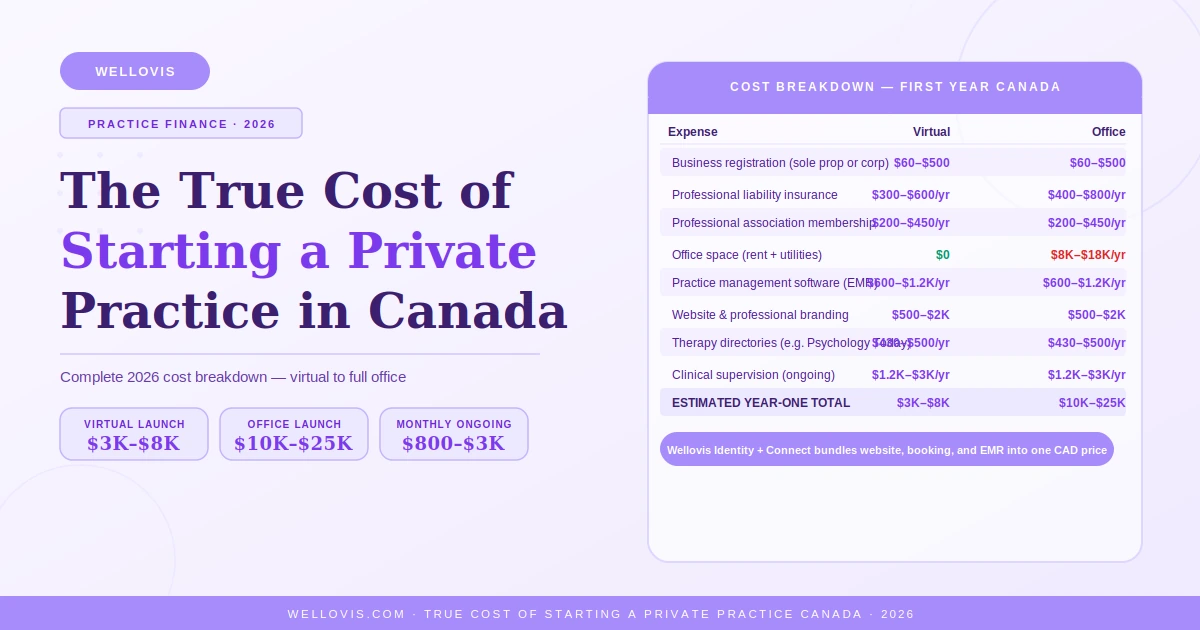
Most guides either dramatically understate or overstate what it costs to launch. Here’s a realistic private practice setup checklist and cost breakdown for Canada in 2026:
- Business registration: $60–$350 depending on province and structure
- Professional liability insurance: $250–$600/year
- Website (done-for-you professional build): $500–$3,000 upfront, or monthly plans from ~$100
- Practice management platform: $50–$150/month — includes scheduling, notes, billing
- Office space (part-time subleased): $300–$800/month — or $0 for fully virtual practices
- Therapist directory listings (Psychology Today etc.): ~$35 USD/month
- Accounting software + CPA consultation: $500–$1,500/year
- Continuing education (regulatory requirement): $300–$1,000/year
Realistic total first-year cost: $4,000–$9,000 for a virtual-primary practice. In-person adds rent. The break-even calculation is straightforward: at $150/session with $1,500/month in fixed costs, you need 10 paying clients per month to cover expenses. At 20+ clients, you’re profitable.
| Cost note: Wellovis packages bundle website, booking tools, compliance setup, and SEO into single monthly plans — eliminating the need to purchase and manage multiple separate services. For many new practitioners, it’s more cost-effective than building the equivalent stack independently. |
Step 10: Build for Growth — From Solo Practice to Group Practice
Once you’re consistently at 20+ clients per week, you’ll hit a ceiling that no amount of efficiency gains can break through: there are only so many hours in a day. The natural evolution for many Canadian practitioners is building a group private practice — bringing on associate therapists to expand capacity without requiring you to personally see more clients.
Scaling introduces new complexity: associate agreements, split billing, clinical supervision requirements, multi-user scheduling, and expanded privacy documentation. Every one of these is manageable — but only with the right systems in place before you hire.
Specifically on supervision: if you’re bringing on provisionally registered therapists or counsellors, your regulatory body requires you to provide documented, structured supervision — not just informal check-ins. Dedicated therapy student practicum management through Wellovis Hours tracks every supervised session, logs competency milestones, and generates the documentation your associates need for registration — automatically, without adding administrative work to your plate.
And as your team grows, therapist scheduling software that handles multi-provider calendars, client assignment, and aggregate reporting becomes essential. Wellovis Connect scales with your practice — from solo booking to full team scheduling — without requiring you to switch platforms or migrate data as you grow.
FAQs on How to Start a Private Practice in Canada
Do I need to incorporate to open a therapy practice in Canada?
No. Most practitioners start as sole proprietors. Incorporation as a Professional Corporation becomes worth exploring when your net annual income consistently exceeds $80,000–$100,000 — at that threshold, the income-splitting and small business tax deduction advantages typically outweigh the setup and annual filing costs.
Can I practise across provinces as a Canadian therapist?
Generally, you must be registered in every province where you provide services — including virtual sessions, where the governing jurisdiction is where the client is located, not where you are. Some provinces have reciprocal agreements or interprovincial mobility provisions; check directly with your regulatory college for current guidance.
How long does it take to fill a private practice caseload in Canada?
Most practitioners reach a full caseload of 20–25 client hours per week within 6–18 months. The variables that accelerate this most reliably are: a well-defined niche, active directory listings, at least one strong GP or specialist referral relationship, and a professional online presence that generates organic enquiries. Practitioners who launch with all four in place consistently fill faster than those who rely on word of mouth alone.
Do I need a website to start a therapy practice in Canada?
Technically, no. Practically, yes — especially for long-term sustainable growth. Your first clients may come through referrals, but within 6–12 months, your website will become your primary client acquisition channel. Building it properly at launch (PIPEDA-compliant, SEO-optimized, with integrated booking) is far easier than retrofitting it later.
Final Thoughts: You Have Everything You Need to Start
Building a private practice in Canada in 2026 is genuinely achievable — not just for practitioners with business backgrounds or big startup budgets, but for any registered clinician willing to approach the business side with the same rigour they bring to their clinical work.
The steps are clear: get registered, get insured, set a sustainable fee, choose the right technology, build a professional online presence, and put your energy into the referral relationships that fill your caseload in months rather than years.
What separates the practices that thrive from the ones that stall isn’t usually clinical skill. It’s having the right systems in place — the right website, the right booking tools, the right compliance setup — so that nothing gets in the way of you doing your actual work.
That’s exactly what Wellovis was built to provide: a complete practice launch platform for Canadian therapists and counsellors who want to start professionally, grow sustainably, and spend their time with clients — not wrestling with technology.