You’ve enrolled in your program. You’re seeing clients. You’re logging hours somewhere — maybe a spreadsheet, maybe a paper form your supervisor gave you, maybe a notes app on your phone. And somewhere in the back of your mind is a quiet, nagging question: am I actually tracking this the right way?
For therapy students and pre-licensed counsellors across Canada, tracking supervision hours for licensure is one of the most consequential administrative tasks of your entire career — and one of the least taught. A documentation error, a miscounted category, or a missing supervisor signature can delay your registration by months.
This guide covers everything you need to know: what supervised practice hours actually count, how requirements differ by regulatory college, the most common tracking mistakes that derail applications, and the tools available to make the process accurate, auditable, and completely stress-free.
|
1,000+ Supervised hours required for most Canadian therapy designations |
3–5 yrs Typical time to complete licensure requirements |
1 in 4 Applications delayed due to documentation errors |
What Are Supervision Hours — and Why Do They Matter for Licensure?
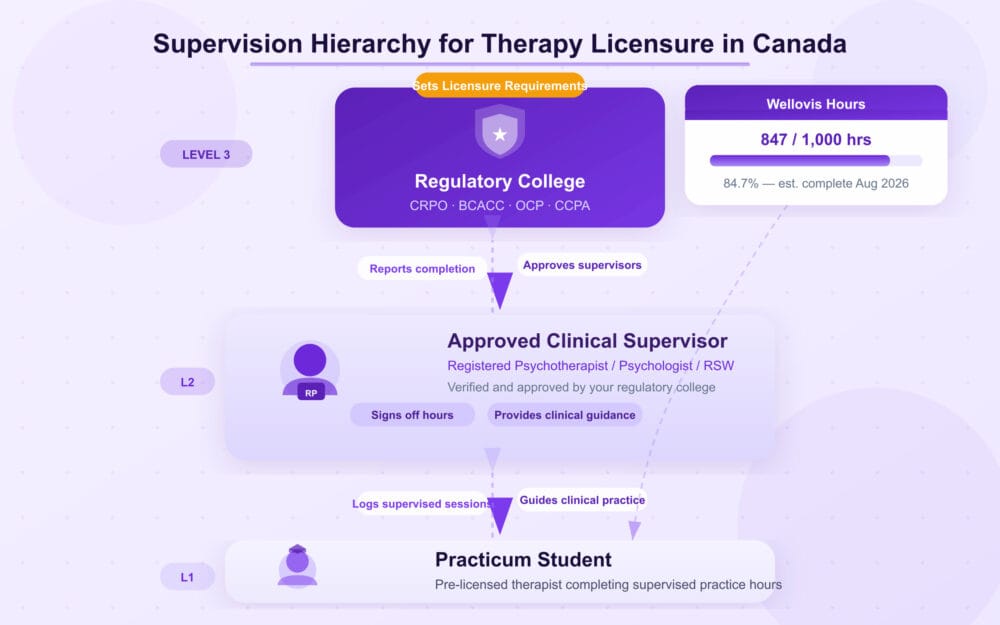
In Canada, regulated mental health professionals — including Registered Psychotherapists (RPs), Registered Social Workers (RSWs), Registered Clinical Counsellors (RCCs), and Psychologists — must complete a defined number of supervised clinical practice hours before they can apply for full registration with their regulatory college.
Supervision hours are not simply hours spent with clients. They fall into distinct categories that your college counts differently — and conflating them is one of the most common and costly mistakes applicants make.
| The 3 Core Categories of Supervision Hours
• Direct client contact hours: Time spent actively providing therapeutic services to clients — individual, couples, family, or group sessions. • Individual supervision hours: One-on-one clinical supervision sessions with your approved supervisor, discussing your cases and clinical development. • Group supervision hours: Supervision in a group format with peers and a supervisor — counted differently (often at a lower ratio) by most colleges. |
Regulatory colleges specify not just the total number of hours required, but the proportion that must fall in each category. For example, a college might require 1,000 total hours, of which at least 500 must be direct client contact and at least 100 must be individual (not group) supervision. Understanding your college’s specific breakdown before you start — not after — is critical.
Supervision Hour Requirements by Canadian Regulatory College
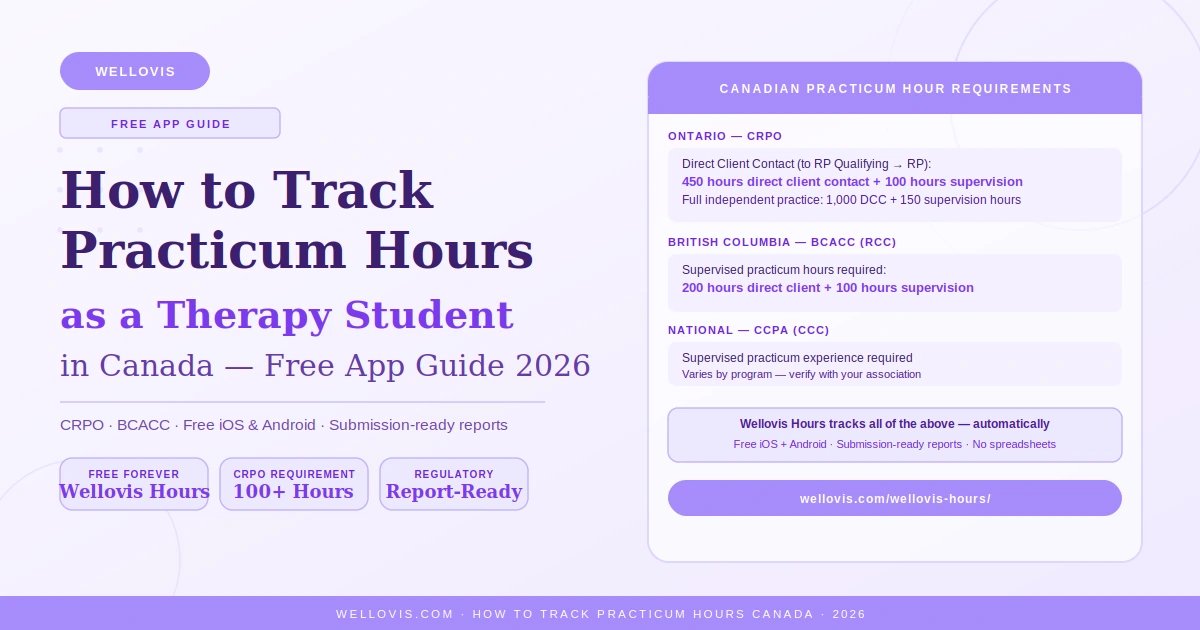
Requirements vary significantly across provinces and designations. Here is an overview of the major regulatory bodies and their supervised practice requirements as of 2026. Always verify directly with your college, as requirements are updated periodically.
| Regulatory College | Designation | Total Hours | Direct Client Hours | Supervision Hours |
| CRPO (Ontario) | RP / RP (Qualifying) | 1,000 hrs minimum | 450+ direct | 10% of total in supervision |
| BCACC (BC) | RCC | 1,000 hrs | 500 direct contact | 50 hrs individual supervision |
| CCPA (National) | CCC | 1,000+ hrs | Varies by setting | 100 hrs supervision |
| OCP (Ontario) | Psychological Associate | 1,600 hrs | Majority direct | 150+ hrs individual |
| CSWSSW (Ontario) | RSW | Varies by category | N/A (competency-based) | Per employer/setting |
| PNWU / PSYPBC (BC) | Registered Psychologist | 1,500+ hrs | 750+ direct | 100 hrs minimum |
Note: This table is for general guidance only. Requirements change — always refer to your college’s current registration requirements.
| Related Reading
→ How to Become a Registered Psychotherapist in Canada (Step-by-Step Guide) → Mental Health Graduate Programs in Canada: Complete Comparison Guide |
How Most Therapy Students Are Currently Tracking Hours (And Why It’s Risky)
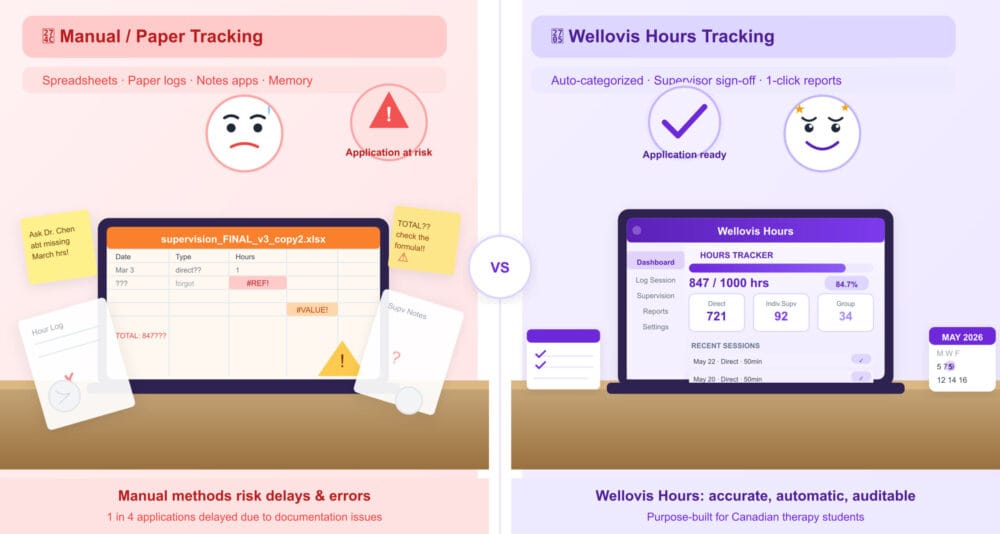
Despite the high stakes of accurate hour documentation, most pre-licensed therapists in Canada are using tools that were never designed for this purpose. Here’s what we commonly see — and why each carries risk:
Spreadsheets
The most common approach. Spreadsheets are flexible, but they lack automatic categorization, have no built-in supervisor verification workflow, and are vulnerable to accidental edits. One deleted row or miscategorized entry can invalidate weeks of documentation. Spreadsheets also offer no tamper-proof audit trail — something some colleges are beginning to scrutinize.
Paper Logbooks
Some training programs still provide paper hour logs. These cannot be backed up, are difficult to share with supervisors for sign-off, and create real risk if lost or damaged. The process of manually totalling categories at application time introduces calculation errors.
General Notes Apps or Calendar Logs
Using Apple Notes, Google Calendar, or similar tools offers no categorization, no supervisor sign-off capability, and no way to generate a formatted summary for college submission. These are documentation liabilities, not documentation systems.
Waiting Until the End
A surprisingly common pattern: students log hours sporadically and then scramble to reconstruct a full record near the application deadline. This approach creates gaps, inconsistencies, and a documentation history that looks irregular — exactly the kind of record that triggers a college to request additional verification.
| Why This Matters More Than You Think
The real cost of poor tracking: Beyond application delays, inaccurate supervision logs can result in having to repeat hours, delaying your practice start date by months. In a field where your start date directly affects your income and your clients, this is not a hypothetical risk. |
What a Proper Supervision Hour Tracking System Must Include
Whether you build a system manually or use dedicated software, a compliant supervision hour tracking log must capture the following data points for every session:
| Required Data Field | Why It Matters for Licensure |
| Date of session | College auditors verify chronological consistency |
| Session duration (exact hours/minutes) | Fractions of hours must be recorded correctly (e.g. 0.75 hrs, not ’45 mins’) |
| Session type (direct / supervision / group) | Wrong categorization is the #1 cause of application rejections |
| Client format (individual / couples / group) | Group client sessions may count at a different ratio |
| Supervisor name and credentials | Supervisor must be approved by your college — this must be verifiable |
| Setting / placement name | Some colleges require hours from specific approved settings |
| Supervisor sign-off / attestation | Unsigned hours are unverifiable — a major audit risk |
| Cumulative running totals by category | Allows you to spot gaps before application, not during |
Step-by-Step: How to Track Your Supervision Hours the Right Way
Here is a practical framework you can implement immediately, regardless of which tools you are currently using.we
Step 1: Get Your College’s Current Requirements in Writing
Before logging a single hour, download your regulatory college’s most current supervision requirements document. Do not rely on what your program told you at orientation, what a senior student told you, or what you remember reading a year ago. Colleges update requirements. Print or save the current version and note the specific hour thresholds for each category.
Step 2: Confirm Your Supervisor’s Approved Status
Not all supervisors are eligible to sign off on hours for your specific designation. Contact your college to verify that your clinical supervisor appears on their approved supervisor list before your first supervised session — not after months of accumulation. This is a non-negotiable first step.
Step 3: Log Every Session Within 48 Hours
Memory degrades fast. The most accurate logs are written the same day or the next morning. Create a non-negotiable habit: after every client session or supervision meeting, open your log and record the session details immediately. The 3 minutes this takes is the cheapest insurance you will ever buy against a delayed registration.
Step 4: Categorize Correctly, Every Time
At the moment of logging, classify the session explicitly — do not leave categorization for later. If you’re unsure whether a session counts as direct contact or indirect (e.g., co-facilitation, observation), ask your supervisor that week. Do not assume.
Step 5: Review Your Running Totals Monthly
At the end of every month, review your cumulative totals across each required category. This monthly check does two things: it catches categorization errors while they’re still recent enough to correct, and it shows you exactly where you stand relative to your licensure target — so there are no surprises at application time.
Step 6: Get Regular Supervisor Sign-Offs
Do not wait until your final application to get your supervisor’s attestation. Build a rhythm — quarterly sign-offs at minimum, monthly if possible. A supervisor who has been signing off progressively is far less likely to dispute hour counts than one being asked to verify 18 months of logs in a single sitting.
Step 7: Back Up Everything — In Two Places
Your hour documentation is irreplaceable. Whether you’re using a spreadsheet, a paper log, or dedicated software, maintain a backup copy in a separate location — a cloud folder, an emailed PDF to yourself, or a secure file-sharing folder shared with your supervisor. Physical logs should be scanned and stored digitally.
| Stop Tracking Hours in Spreadsheets. There’s a Better Way.
Wellovis Hours automatically logs, categorizes, and tracks your supervised practice hours — with built-in supervisor sign-off and a submission-ready report for your college application. → Start Tracking with Wellovis Hours — Free (Free to get started — no credit card required) |
The 7 Most Common Supervision Hour Tracking Mistakes — and How to Avoid Them
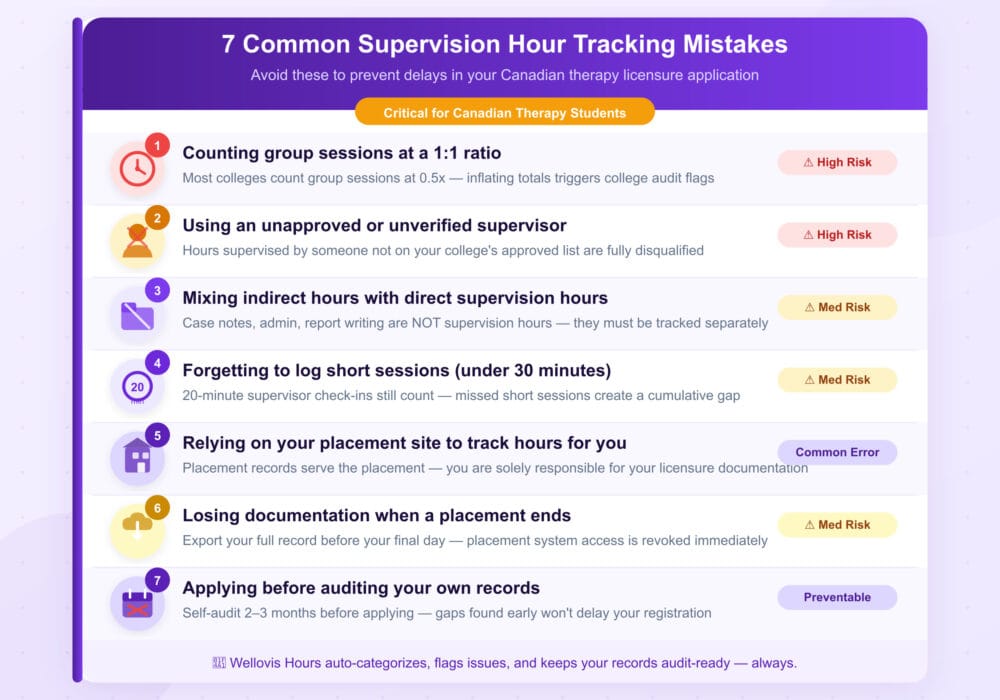
- Counting group client sessions at a 1:1 ratio. Most colleges count group sessions at 0.5 or 0.33 per hour of group time for direct hours. Counting them as full direct hours inflates your totals and creates a discrepancy auditors will catch.
- Mixing qualifying and non-qualifying supervisors. If any of your hours were supervised by someone who is not approved by your college for your designation, those hours will be disqualified regardless of quality or quantity.
- Not separating indirect hours. Case consultation, report writing, and administrative tasks may log as professional development but do not count as direct supervision hours. Conflating them misrepresents your record.
- Forgetting to log shorter sessions. A 20-minute check-in with your supervisor still counts. Students frequently forget to log sessions under 30 minutes, creating a cumulative gap over time.
- Relying on your placement to track hours for you. Your placement site may keep records, but their records serve their purposes — not your licensure application. You are responsible for your own documentation.
- Losing documentation when a placement ends. When a practicum ends, access to placement systems often ends with it. Export or backup your records before your final day at any placement.
- Applying before auditing your own records. A large proportion of application delays are preventable. Running a self-audit 2–3 months before your planned application date gives you time to identify and address any gaps.
| Related Reading
→ What to Expect During Your Therapy Practicum in Canada → How to Choose the Right Clinical Supervisor for Your Therapy Training |
How Wellovis Hours Solves the Supervision Tracking Problem for Canadian Therapy Students
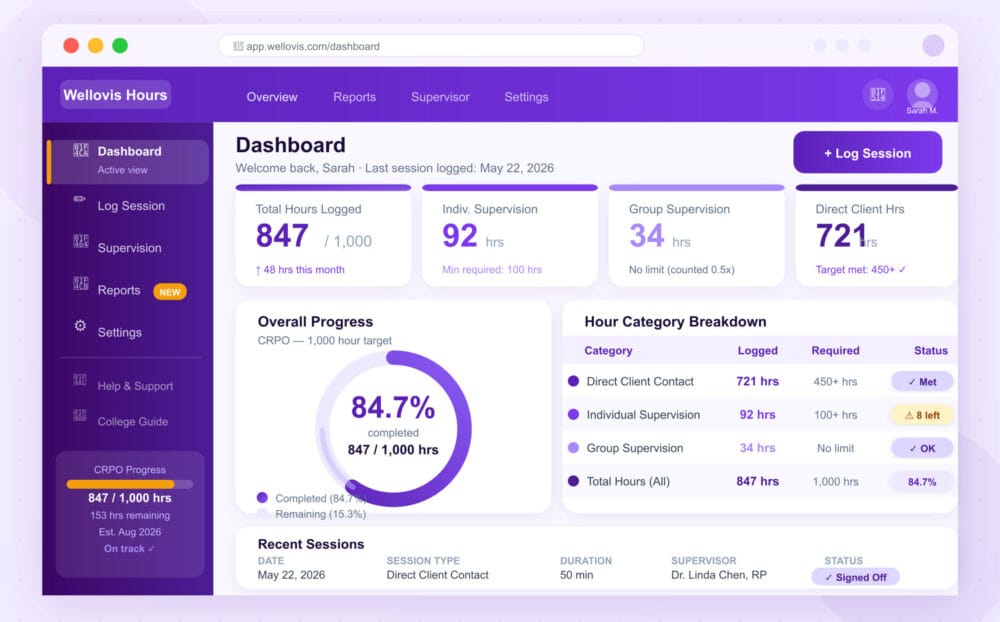
Manual tracking systems — spreadsheets, notebooks, notes apps — put the entire burden of accuracy, categorization, and compliance on you. Wellovis Hours was built specifically for Canadian therapy students and pre-licensed counsellors to remove that burden entirely.
Automatic Categorization
When you log a session in Wellovis Hours, the system automatically categorizes it based on session type — individual direct contact, group direct contact, individual supervision, or group supervision — and applies the correct counting logic for your designated regulatory college. You don’t need to know your college’s ratio rules by heart. The platform knows them for you.
Supervisor Sign-Off Built In
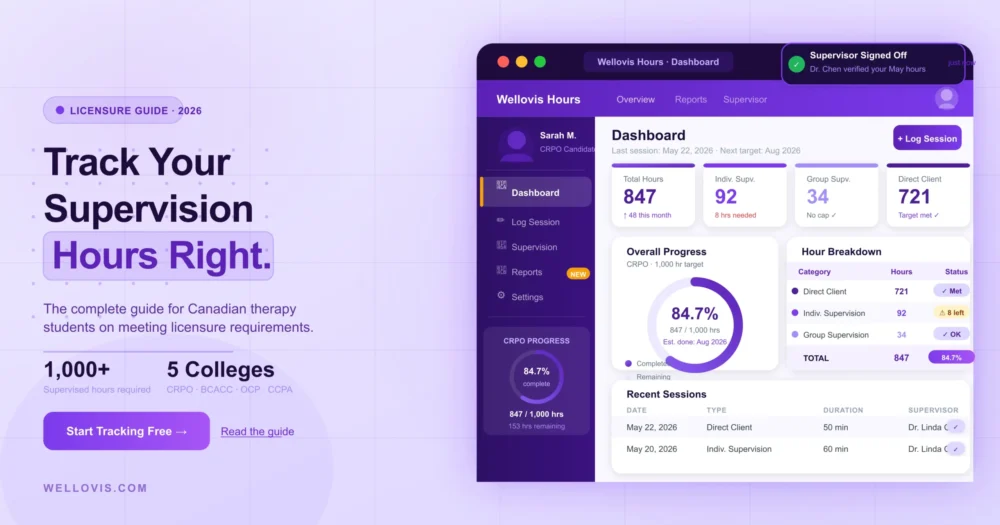
One of the most friction-heavy parts of manual hour tracking is chasing your supervisor for signatures. Wellovis Hours includes a built-in digital supervisor attestation workflow: your supervisor receives a periodic summary, reviews it, and signs off electronically — creating a verified, timestamped record that is fully auditable and accepted by Canadian regulatory colleges.
Running Totals Across Every Category
Your dashboard shows real-time cumulative totals for each required category, a visual progress tracker toward your licensure target, and a projected completion date based on your current logging pace. You always know exactly where you stand.
Submission-Ready Reports in One Click
When it’s time to apply for registration, Wellovis Hours generates a formatted supervision hour summary report formatted to the requirements of your specific college — ready to attach to your application without any manual compilation.
Secure, Private, and PIPEDA-Compliant
Your supervision records contain sensitive clinical details. Wellovis is built on Canadian servers with PIPEDA-compliant data handling — so your records are protected under Canadian privacy law, not US or EU frameworks.
| Wellovis Hours + Wellovis Connect: Built for the Full Licensure Journey
Wellovis Hours integrates seamlessly with Wellovis Connect — our peer community and mentorship network for Canadian therapy students. While Wellovis Hours handles your hour documentation, Wellovis Connect connects you with peers who are navigating the same licensure journey, supervisors looking for qualified supervisees, and mentors who have recently completed the process. Because tracking hours is easier when you don’t have to figure it all out alone. |
Supervision Hours FAQs
Q. Do online or telehealth sessions count as direct supervised hours?
Yes — for most Canadian regulatory colleges, therapy sessions conducted via secure video platform count as direct client contact hours, provided they meet the college’s standards for therapeutic service delivery. Verify with your specific college, as some have minimum requirements for in-person hours.
Q. Can I start logging hours before my supervisor is officially approved by my college?
This is a serious risk. If your supervisor is not on your college’s approved list at the time of your sessions, those hours may not be counted. Always verify supervisor approval status before your first supervised session.
Q. Do hours from a previous practicum placement transfer if I change programs?
This depends on your college and your new program. Some colleges allow portability of hours if they were completed under an approved supervisor and documented properly. Always contact your college directly before assuming prior hours will count.
Q. How many supervision hours per week do I need to be completing?
There is no universal minimum weekly rate, but to complete 1,000 hours within a standard 2–3 year program, students typically need to see 8–15 clients per week and hold bi-weekly supervision. If you’re behind pace, Wellovis Hours‘s pace projection feature will tell you exactly how many weekly hours you need to meet your target date.
Q. What happens if my supervisor refuses to sign off on my hours?
This is rare but it does occur. If a supervisory relationship ends poorly, having digital records with timestamped session logs — rather than paper logs that require physical sign-off — provides an independent documentation trail. This is another reason to maintain your own records independently of what your supervisor or placement site keeps.
Q. Can I use a spreadsheet and then transfer the data to a formal log at the end?
Technically yes, but this approach creates significant risk. A log that was clearly compiled retroactively — with entries all added on the same date — can raise questions about its accuracy. Progressive, contemporaneous documentation (logging at or near the time of each session) is the standard expected by regulatory colleges.
Building Your Supervision Hour Tracking Routine: A Weekly Checklist
Tracking supervision hours accurately is less about the tool you use and more about the habit you build around it. Here is a simple weekly routine that takes under 15 minutes and keeps your documentation consistently up to date:
| When | Action |
| After each session | Log session type, duration, supervisor, setting, and client format within 24 hours |
| Every Friday | Review the week’s entries — check for any missing sessions or mis-categorizations |
| Monthly | Review running totals across all categories against your college’s required breakdown |
| Quarterly | Send supervisor a summary log and request sign-off / attestation |
| Every placement end | Export and back up your complete record before system access is removed |
| 3 months pre-application | Run a full self-audit — total hours vs. requirement, category breakdown, supervisor sign-offs complete |
The Bottom Line on Tracking Supervision Hours for Licensure
Your supervised practice hours are the foundation of your professional registration. They represent years of clinical work, personal growth, and supervised learning — and the documentation that proves it should be treated with the same care you bring to your clinical practice.
The good news: with the right system, tracking supervision hours for licensure doesn’t have to be complicated. It requires a commitment to logging in real time, an understanding of your college’s specific category requirements, and a tool that automates the compliance rules so you can focus on the work that matters.
Whether you’re in your first practicum placement or approaching your final application, the principles are the same: log early, categorize correctly, verify your supervisor’s status, get periodic sign-offs, and back up everything.
| Track Every Supervised Hour. Reach Licensure Faster.
Wellovis Hours is the purpose-built supervision tracking platform for Canadian therapy students and pre-licensed counsellors. Automatic categorization, supervisor sign-off workflows, and one-click college submission reports — all PIPEDA-compliant, all built for Canada. → Start Tracking Free with Wellovis Hours (Free to get started — no credit card required) |