It’s 5:30 PM. Your last client just left. You have four sessions to document — and you already know you’ll be at your desk until 7, maybe 7:30, doing work that has nothing to do with therapy. You went into this profession to help people. Not to type notes about helping people.
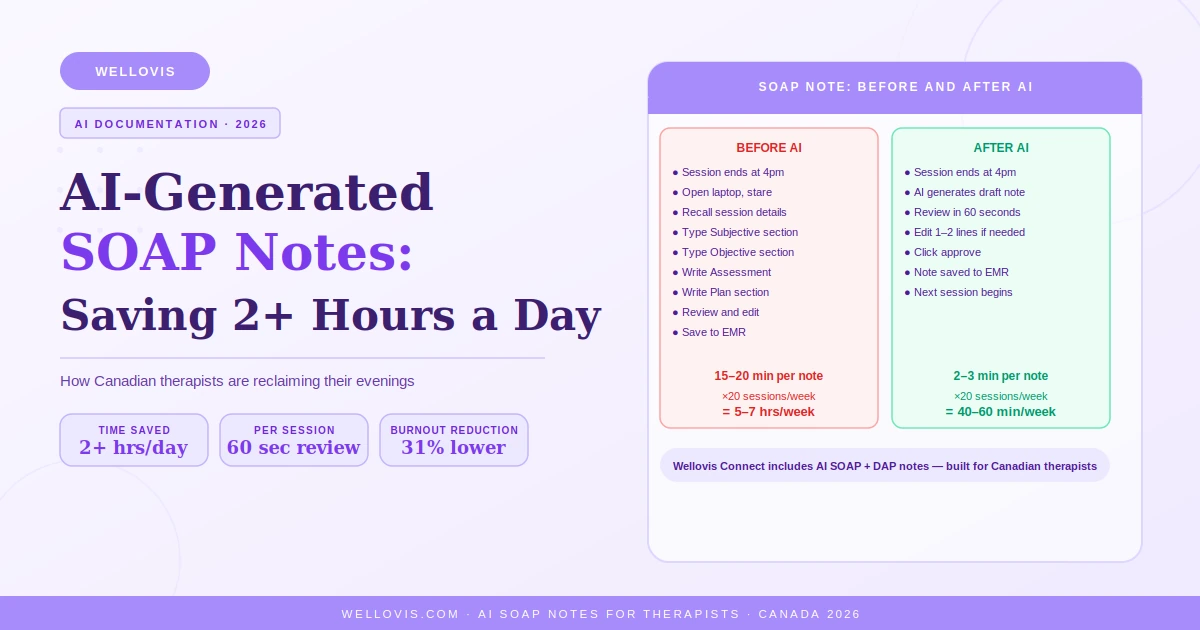
This is the quiet reality for most therapists in private practice in Canada. Clinical documentation — SOAP notes, DAP notes, progress notes, treatment plans — consumes an average of 15–20 minutes per session. For a full-time caseload of 20 clients per week, that’s 5–7 hours of administrative work every single week. That’s an entire clinical day, lost to paperwork.
In 2026, AI-generated SOAP notes are changing this for therapists across Canada and worldwide. This guide covers exactly how AI clinical documentation works, what PHIPA compliance looks like in practice, what the research shows about time savings, and how Wellovis Connect’s built-in AI note feature gives Canadian therapists all of this without a separate subscription or tool.
💡 Quick stat: A 2026 study of 8,581 clinicians found AI scribe use was associated with approximately 16 fewer minutes per day on documentation. For a therapist with a full caseload, that compounds to over 65 hours reclaimed per year. A multicenter study published in JAMA Network Open found a 31% reduction in burnout among physicians using ambient AI scribes.
What Is a SOAP Note and Why Is It the Standard?
SOAP notes have been the standard clinical documentation format in healthcare for over five decades — and they remain the expected format for most therapy progress notes, insurance submissions, and regulatory audits in Canada.
SOAP stands for:
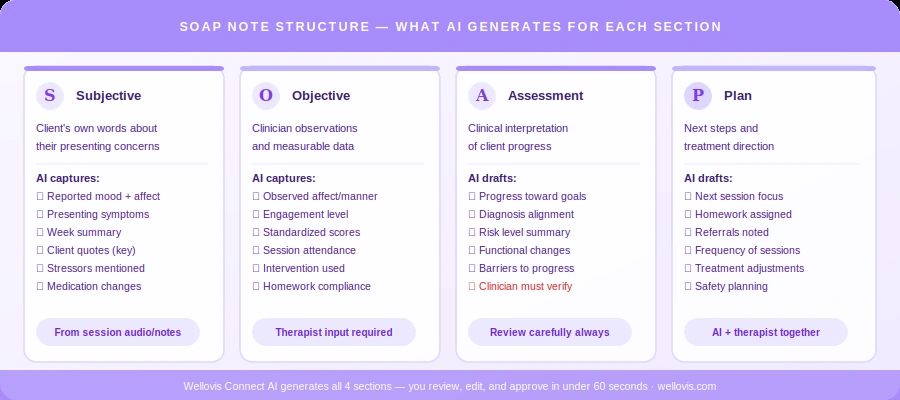
- S — Subjective: What the client reported — their own words about their presenting concerns, mood, symptoms, and week since the last session.
- O — Objective: What the clinician observed — affect, engagement, mental status, standardized assessment scores, attendance.
- A — Assessment: The clinician’s interpretation — progress toward treatment goals, diagnosis alignment, risk level, functional changes.
- P — Plan: Next steps — what will be addressed next session, homework assigned, referrals made, treatment adjustments.
The structure doesn’t change. What has changed dramatically in 2026 is how each section gets written — moving from a blank page the therapist fills manually to an AI-generated draft the therapist reviews, edits, and approves.
SOAP vs DAP Notes: What’s the Difference and Can AI Generate Both?
While SOAP is the most common format, many therapists — particularly those in mental health private practice — use DAP notes instead:
- D — Data: Combines the Subjective and Objective sections — everything that was observed and reported in session.
- A — Assessment: Same as SOAP — the clinician’s interpretation of what occurred and what it means for treatment.
- P — Plan: Same as SOAP — next steps, homework, and treatment direction.
DAP notes are often preferred by psychotherapists in private practice because they eliminate the sometimes artificial separation between subjective and objective content in a talk therapy context — where most of what happens is subjective by nature. Both formats are accepted by Canadian regulatory bodies including CRPO and BCACC for session documentation.
Wellovis Connect’s AI documentation feature generates both SOAP and DAP notes — allowing each therapist to choose the format that matches their practice style and regulatory requirements.
How AI SOAP Note Generation Actually Works
Understanding the mechanics helps therapists use AI documentation tools with appropriate confidence and appropriate caution.
Input methods
AI SOAP note tools typically accept input through one of three methods:
- Session audio recording: The most comprehensive input — the AI processes the session transcript to generate notes from the actual conversation. Requires explicit informed consent from the client before recording.
- Dictation after session: The therapist speaks a brief summary after the session ends. The AI structures this into a formatted SOAP or DAP note. No recording of the client session required.
- Brief text summary: The therapist types a few bullet points about the session. The AI expands these into a complete, structured note. Fastest input method; requires the least technology setup.
Wellovis Connect uses a combination of dictation and text input — the therapist provides a brief post-session summary, and the AI generates a complete SOAP or DAP note within seconds for review and approval. This approach does not require session recording, which simplifies the consent process considerably.
What the AI does with your input
The AI uses natural language processing to:
- Extract and organize clinical content into the appropriate SOAP or DAP section
- Apply consistent clinical language and formatting
- Generate a complete draft in the correct structure for your regulatory body
- Maintain your clinical voice — the note reads like you wrote it, not like a machine
The therapist then reviews the draft, makes any edits, and approves it. The whole review process takes under 60 seconds for most notes. The note is then stored in your EMR — in the case of Wellovis Connect, integrated directly into the client’s record in the platform.
The Time Savings: What the Research Actually Shows
The time savings from AI SOAP note generation are well-documented in 2026 research:
- Per-session time: Documentation that previously took 15–20 minutes per session is consistently reduced to 2–3 minutes with AI-assisted generation — a reduction of over 85%.
- Per-day time: A 2026 study of 8,581 ambulatory clinicians found AI scribe use was associated with approximately 16 fewer minutes per day spent on documentation.
- Per-year time: Research indicates AI documentation tools save 5–15 minutes per session — translating to up to 300 hours per clinician per year for a full caseload.
- Burnout impact: A multicenter study published in JAMA Network Open found a 31% reduction in reported burnout and a 30% boost in physician wellbeing among clinicians using ambient AI scribes.
For a therapist carrying 20 sessions per week, the math is straightforward. At 15 minutes per note manually versus 2 minutes with AI, the weekly saving is approximately 3.5–4 hours. That’s an extra half-day returned to clinical work, supervision, CPD, or — crucially — leaving work at a reasonable hour.
💡 The compounding effect: Many therapists find that when documentation no longer bleeds into their evenings, they have the mental capacity to see one or two additional clients per week. At $150 per session, 2 additional sessions per week adds $15,600 to annual revenue — making AI documentation a revenue tool, not just an efficiency tool.
PHIPA Compliance and AI Notes: What Canadian Therapists Need to Know
This is the critical question for Canadian therapists — and the one that determines whether an AI documentation tool is usable in practice or a liability.
PHIPA (Ontario’s Personal Health Information Protection Act) and equivalent provincial legislation govern how personal health information — including everything discussed in a therapy session — is collected, stored, used, and transmitted. Any AI tool that processes session content must comply with these requirements.
Key PHIPA requirements for AI documentation tools
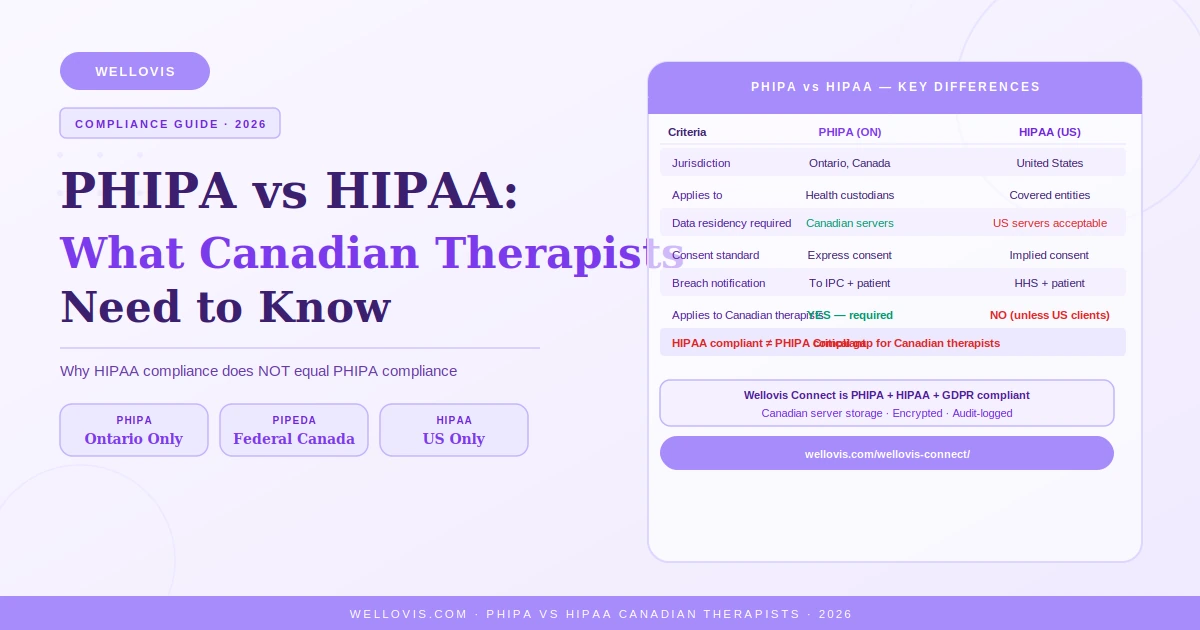
- Canadian data residency: Client health information processed by an AI tool should be stored on Canadian servers, not US servers. A tool that routes your session data through US-based infrastructure creates PHIPA exposure regardless of its HIPAA compliance. This is the most common compliance gap in US-built AI tools used by Canadian therapists.
- Informed consent for AI processing: If your AI documentation tool processes session audio or transcripts, your clients must be informed and must consent to this processing. This consent should be documented in your intake forms. If your tool uses post-session dictation or text summaries (rather than session recordings), the consent requirements are simpler.
- Data minimization: The AI tool should process only the information necessary to generate the note — not retain raw session transcripts indefinitely or use session data to train future AI models without consent.
- Access controls and audit logging: The system storing AI-generated notes must have appropriate access controls and maintain an audit log of who accessed what, when.
Wellovis Connect is built PHIPA, HIPAA, and GDPR compliant from the ground up — with Canadian server storage, encrypted data handling, and audit logging integrated into the platform. The AI note feature operates within this same compliance framework, so therapists using Wellovis aren’t adding a separate non-compliant AI tool to their workflow — they’re using an AI feature within an already-compliant Canadian platform.
For more on PHIPA compliance and what to look for in your practice management software, read our full EMR comparison for Canadian therapists.
What AI Can and Cannot Do in Clinical Documentation
AI SOAP note tools are genuinely powerful — but understanding their limitations is as important as understanding their capabilities. Therapists who use AI documentation tools most effectively treat them as a first draft, not a finished product.
What AI does well
- Structure and formatting: AI consistently applies the correct SOAP or DAP structure, eliminating the blank-page problem and ensuring every section is present.
- Organizing session content: AI is very good at taking unstructured input (your dictation or bullet points) and organizing it into the right sections of a clinical note.
- Clinical language: AI applies consistent, professional clinical language — reducing the informal phrasing that sometimes creeps into manually written notes at the end of a long day.
- Speed: From input to draft note, AI generates a complete SOAP note in seconds — not 15 minutes.
- Consistency: Every note is formatted the same way. This matters significantly for audit-readiness and insurance documentation.
Where therapist review remains essential
- Clinical accuracy of the Assessment section: The AI’s interpretation of a client’s progress toward treatment goals must always be verified by the clinician. AI can draft; only you can clinically assess.
- Risk and safety content: Any note involving suicidality, self-harm risk, or safety planning must be reviewed with particular care. AI can identify that risk content was discussed and include it — but the clinical weight and accuracy of this section requires your professional judgment.
- Hallucination risk: All large language models can generate plausible-sounding but factually incorrect content. In clinical documentation, an AI note that includes a symptom that was not discussed, or attributes a statement to the client that wasn’t made, is a clinical and legal problem. Therapist review before approval is non-negotiable — not optional.
- Nuance and clinical narrative: AI notes are typically accurate but occasionally miss the subtle clinical threads that experienced therapists carry across sessions. Your clinical judgment about what matters most in this session, in this client’s particular treatment trajectory, cannot be fully automated.
💡 The right mental model: Think of AI SOAP notes the way you think about a very good intern who has excellent formatting skills and good memory — but whose clinical judgment you always verify before the note goes on the record. The efficiency gain is real. The clinical responsibility remains entirely yours.
📖 Related Reading
How AI SOAP Notes Work Inside Wellovis Connect
Most AI documentation tools require therapists to sign up for a separate subscription, export notes from the tool, and then manually paste them into their EMR. This creates an extra step, an extra platform to manage, and often a data flow that raises PHIPA questions.
Wellovis Connect integrates AI SOAP and DAP note generation directly into the practice management platform — so the AI note feature is inside the same PHIPA-compliant system you’re already using for scheduling, billing, client records, and telehealth. There’s no separate tool. No copy-pasting. No data leaving the compliant environment.
Here’s how the workflow looks in practice:
- Session ends. You open the Wellovis Connect session note for that client — it’s linked to the appointment in your calendar automatically.
- Brief input. You dictate or type a 2–3 sentence summary of the session — the main themes, interventions used, client response, and any plan changes.
- AI generates the draft. Within seconds, a complete SOAP or DAP note appears — structured, formatted, and written in professional clinical language.
- You review. Scan the note. Edit any inaccuracies. Add any nuance the AI missed. This typically takes under 60 seconds.
- You approve. The note is signed and saved to the client’s record. Your next session can begin.
Because the note lives in the same platform as your scheduling, billing, and client history, everything is connected. No separate logins, No data silos, No compliance gaps between tools.
Informed Consent: What to Tell Clients About AI Documentation
Transparency with clients about how their session information is used to generate notes is both an ethical requirement and a trust-building practice. Here’s what to include in your intake documentation and informed consent process:
- If you use dictation or text summary input (not session recording): Inform clients that you use AI-assisted tools to help structure your clinical notes based on your post-session summaries. Explain that you always review and approve every note before it’s saved to their record. This is straightforward to include in your standard consent forms.
- If you use session audio recording: Full informed consent is required before any session is recorded. This must include what the recording is used for, who has access to it, how long it’s retained, and how it’s protected. For most private practice therapists, dictation-based input avoids this complexity entirely.
- What clients usually want to know: That their information stays private, that a human clinician reviews every note, and that the AI doesn’t make decisions about their care — it only helps structure documentation after the session. Most clients respond positively to this explanation, particularly when you frame it as a tool that lets you be more present in sessions rather than thinking about documentation.
Best Practices for Using AI SOAP Notes in Your Practice
- Always review before approving. This is not optional. An AI-generated note that contains an inaccuracy and is approved without review is your clinical and legal responsibility. The 60-second review is the non-negotiable part of the workflow — not a step you skip when you’re busy.
- Input immediately after the session while your memory is fresh. The quality of your AI-generated note is directly proportional to the quality of your input. A brief, accurate dictation right after the session produces a better note than a reconstruction hours later.
- Develop a consistent dictation format. A 3–4 sentence post-session summary that covers: (1) main themes discussed, (2) interventions used and client response, (3) any risk or safety content, and (4) plan for next session — gives the AI everything it needs to generate a complete note.
- Pay particular attention to the Assessment section. This is where AI is most likely to generate plausible but clinically inaccurate content. Your interpretation of what the session means for this client’s treatment trajectory is yours — not the AI’s.
- Keep AI notes in your PHIPA-compliant system. If you’re using a standalone AI note tool that requires you to export notes and paste them elsewhere, you’re creating a data flow outside your compliant environment. Using a platform like Wellovis Connect where AI notes are generated within the compliant EMR eliminates this risk entirely.
- Disclose in your consent forms. Update your informed consent documentation to include how AI tools are used in your practice. This is good practice regardless of your jurisdiction and positions you as a transparent, professional practitioner.
📖 Related Reading
Frequently Asked Questions
Can AI write my therapy notes for me?
AI can generate a complete draft SOAP or DAP note based on your post-session input — but it cannot replace your clinical review and approval. Think of it as a highly efficient documentation assistant: it handles the structure, formatting, and organization; you handle the clinical judgment. Wellovis Connect includes built-in AI SOAP and DAP note generation within its PHIPA-compliant platform, so you review and approve the AI draft before it’s saved to the client’s record.
Are AI-generated SOAP notes PHIPA compliant?
It depends entirely on which tool you use and how it’s configured. A PHIPA-compliant AI note tool must store data on Canadian servers, process only the minimum information needed to generate the note, maintain appropriate access controls and audit logs, and operate under a proper data processing agreement. Many US-built AI note tools are HIPAA compliant but not PHIPA compliant — meaning Canadian therapists using them may be creating regulatory exposure without realizing it. Wellovis Connect’s AI note feature is built within a PHIPA-compliant framework with Canadian data residency.
How much time do therapists spend on documentation?
Most therapists spend 15–20 minutes writing a SOAP note manually after each session. For a caseload of 20 sessions per week, that’s 5–7 hours of documentation time per week — approximately one full clinical day. Research in 2026 consistently shows that AI-assisted documentation reduces per-session note time to 2–3 minutes, saving 3–5 hours per week for a full-time therapist.
What is the difference between a SOAP note and a DAP note?
A SOAP note has four sections: Subjective (client’s report), Objective (clinician’s observations), Assessment (clinical interpretation), and Plan (next steps). A DAP note combines Subjective and Objective into a single Data section, then Assessment and Plan. DAP notes suit talk therapy where the subjective/objective distinction is often unclear. Canadian regulatory bodies including CRPO and BCACC accept both formats. Wellovis Connect generates both formats.
Do I need to tell my clients I’m using AI to generate my notes?
Ethically, yes — and in some regulatory frameworks, legally. Disclosing your use of AI documentation tools is both a PHIPA requirement and a professional ethics standard. For dictation-based tools, the disclosure is straightforward. Tell clients you use AI to help structure your post-session summaries. No session audio is recorded. You review and approve every note before it is saved to their record. Most clients respond positively. It positions you as a transparent practitioner who uses modern tools responsibly. Update your informed consent forms to include this disclosure.
Does using AI for notes reduce the quality of my clinical documentation?
“In 2026, AI-assisted notes match or exceed the consistency of manually written ones. The key is review: editing the AI draft catches inaccuracies and adds clinical nuance. A therapist who approves AI notes without reading them is creating a compliance and quality risk. Reviewed and refined, AI drafts consistently outperform tired end-of-day manual notes.