The question every therapist asks before making the leap to private practice is the same: How much money do I actually need? And the honest answer — which almost no one gives clearly — is: it depends on one decision more than any other. Whether you go virtual or whether you rent physical office space.
That single decision is the difference between launching a Canadian therapy private practice for $3,000–$8,000 in year one or committing to $10,000–$25,000+. Everything else — insurance, EMR, directories, associations — is relatively similar across practice models. Office rent is the variable that changes everything.
This guide gives you a complete, honest cost breakdown for starting a private practice in Canada in 2026 — line by line, in Canadian dollars, for both virtual and office-based models. By the end, you’ll know exactly what to budget, which costs are non-negotiable, which are optional, and how to reduce your overhead from day one.
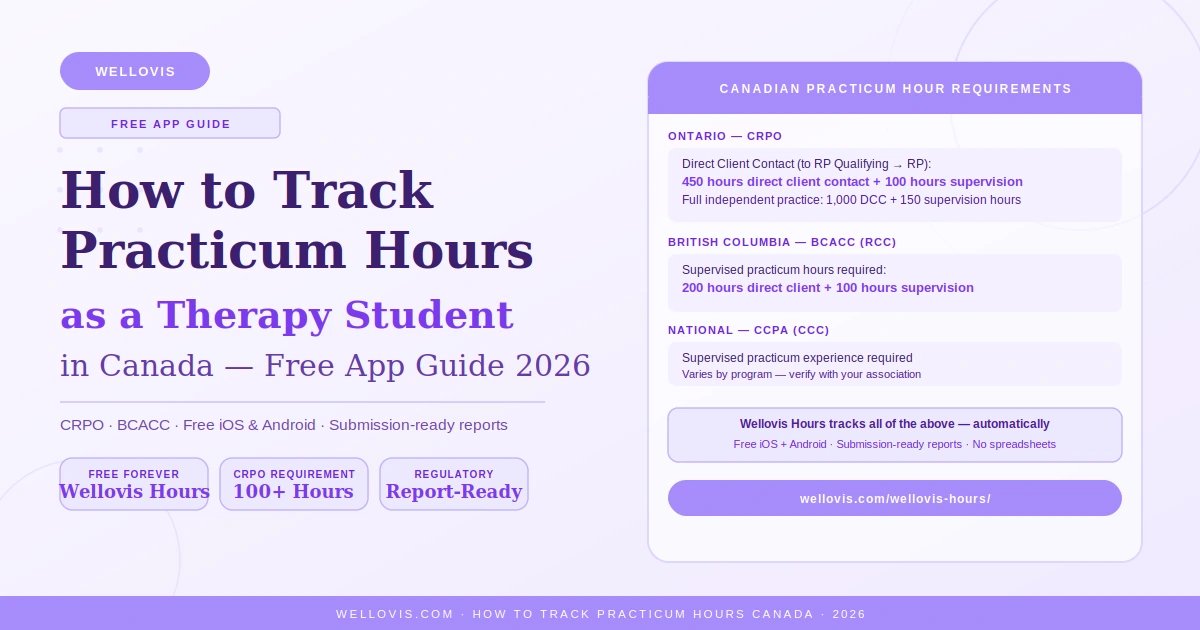
💡 Already tracking your supervised hours? Before you calculate practice costs, make sure your practicum hours are in order. Read our guide on how to track practicum hours as a therapy student in Canada and how to track supervision hours for licensure before making the jump to private practice.
Before the Costs: The Number That Matters More Than Your Budget
Most guides lead with startup costs. The more important number is your financial runway — how many months of personal living expenses you have in savings before your practice needs to support you.
Most Canadian therapy practices take 4–6 months to fill to a viable caseload. Some take a year. The therapists who launch successfully are almost always the ones who have 3–6 months of personal expenses in savings before their first client walks in the door — not just enough to cover startup costs, but enough to live on while the practice builds.
Calculate your personal monthly expenses — rent, food, transport, loan payments — multiply by 4. That’s the minimum runway you should have before launching full-time. This number matters more than whether your website cost $500 or $2,000.
One-Time Startup Costs: What You Pay Before Your First Client
Business Registration — $60–$500
Most Canadian therapists launch as a sole proprietor, which in Ontario costs $60 to register a business name with the provincial government. Some practitioners incorporate a professional corporation (PC) for tax advantages — typically worth considering once you’re earning $100,000+ annually. Professional corporation registration costs $500–$1,500 in legal and government fees. If you’re unsure which structure is right for you, consult a Canadian accountant who works with healthcare professionals before deciding.
Professional Liability Insurance — $300–$800/year
Non-negotiable. Malpractice (professional liability) insurance protects you if a client makes a claim related to your professional practice. In Canada, most therapists purchase coverage through their professional association — CRPO members can access coverage through the Canadian Psychological Association’s insurance program; CCPA members through CCPA-endorsed plans. Annual premiums for solo therapists typically run $300–$600/year through association programs. If you require general liability coverage for a physical office (slip and fall, property damage), budget an additional $200/year.
Professional Association Membership — $200–$450/year
Membership in a recognized professional association is required for most Canadian therapists’ regulatory registration and insurance access. CCPA membership runs approximately $280–$350/year. CRPO registration fees (separate from association membership) run $190–$225/year for registered members. BCACC membership runs $340–$420/year for full members. Budget $200–$450/year depending on your credential and province.
Professional Website and Branding — $500–$2,500 (one-time)
Your website is your most important marketing asset — it’s where every referral, every Google search, and every directory listing sends potential clients to decide whether to book. A poorly built website or no website costs you clients every single week. The range is wide: a DIY WordPress site with a paid theme runs $200–$500 in your first year; hiring a freelance designer runs $1,500–$5,000; a purpose-built therapy platform like Wellovis Identity gives you a done-for-you PHIPA-compliant, SEO-optimized therapy website with integrated booking included in the platform cost.
💡 Hidden cost most new therapists miss: A website without integrated online booking loses after-hours clients. Studies show 18–22% of therapy bookings happen outside business hours. A contact form that promises a 48-hour reply is not a booking system. Wellovis Connect integrates 24/7 self-booking directly into your website, which is one of the highest-ROI investments you can make in year one.
Office Space (If Applicable) — $0 to $18,000+/year
This is the single largest cost variable in a Canadian therapy practice. Options range from:
- Home office (virtual practice): $0 in additional rent. Some home internet and equipment costs are tax-deductible as a percentage of your home office use. This is the fastest path to profitability for most new therapists.
- Shared office / hourly sublet: $20–$50/hour, booked only when you see in-person clients. For a therapist seeing 8 in-person clients per week, budget $800–$2,000/month. Lower risk than a lease — no fixed commitment.
- Dedicated office sublet or suite: $800–$2,000/month in major Canadian cities (Toronto, Vancouver, Calgary). In smaller cities, $400–$900/month. A one-year lease commitment before you have a full caseload is the most common financial mistake new therapists make.
Ongoing Monthly Costs: What You Pay to Keep the Lights On
Practice Management Software (EMR) — $50–$120/month CAD
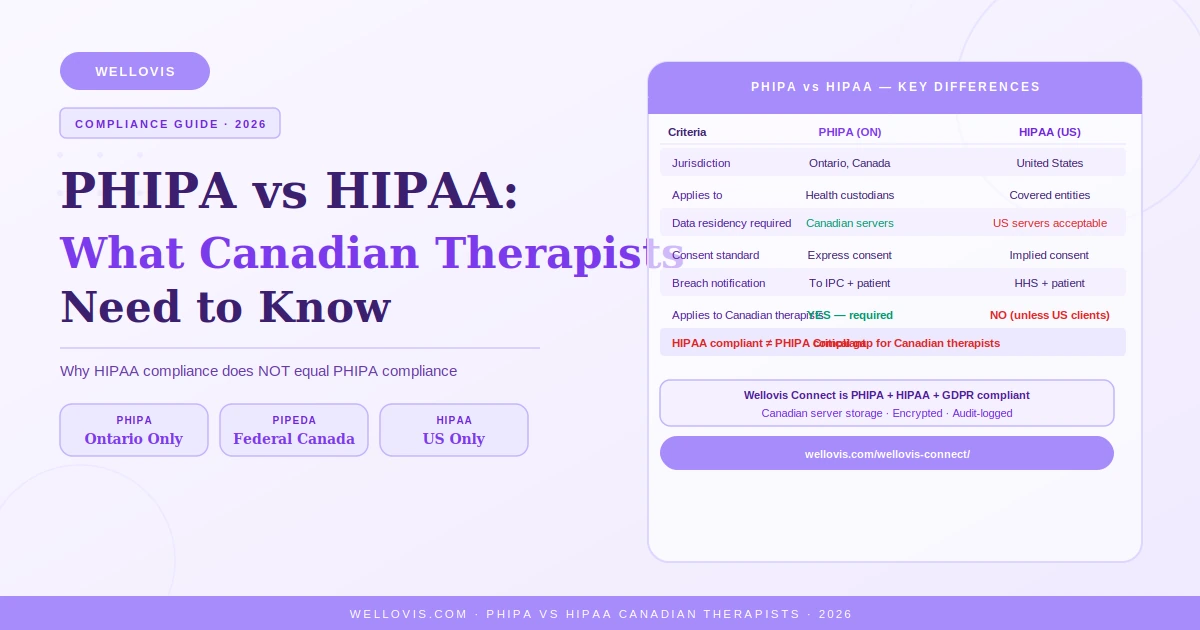
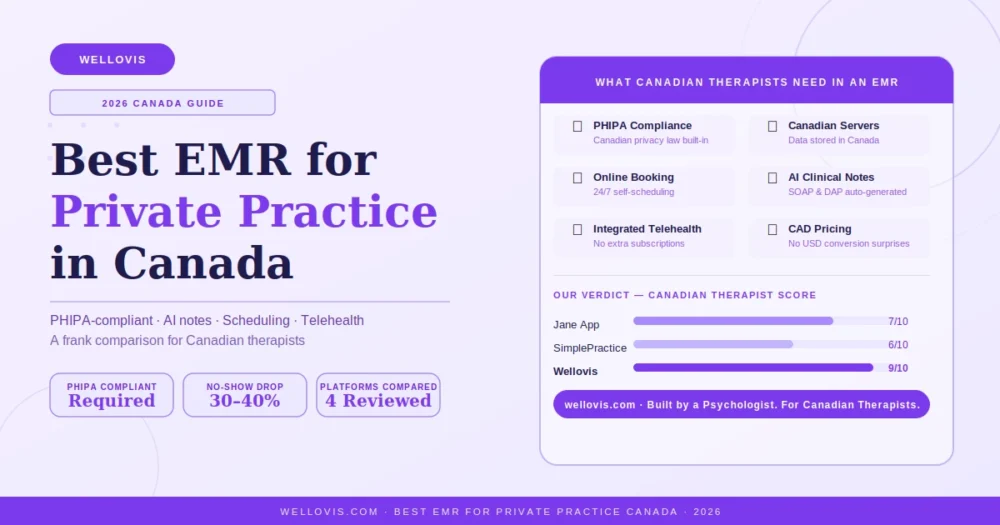
Every Canadian therapist needs a PHIPA-compliant practice management platform for scheduling, client records, clinical notes, and billing. This is not optional — using a non-compliant tool (including many US-based platforms priced in USD) creates regulatory exposure. See our full EMR comparison for Canadian therapists for a detailed breakdown. Key options and their approximate CAD costs:
- Jane App: $79 CAD/month base + $20/month for Canadian insurance eClaims = $99+/month
- SimplePractice: $49–$99 USD/month (HIPAA compliant only — PHIPA compliance is your responsibility) = $68–$138 CAD/month
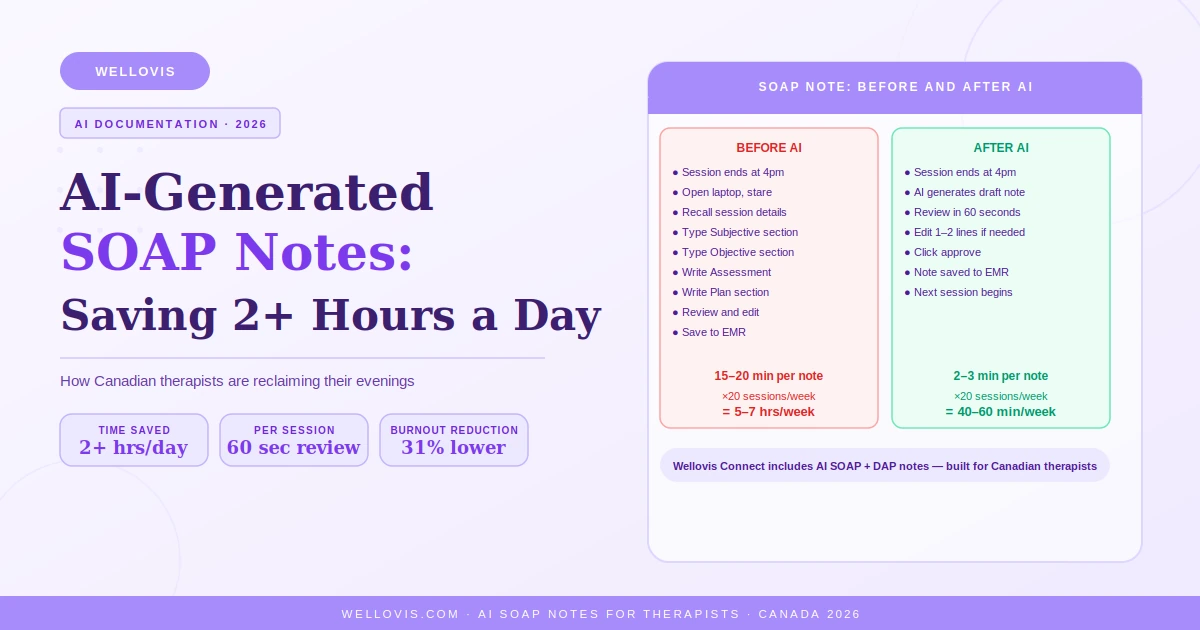
- Wellovis Connect: Transparent CAD pricing, PHIPA+HIPAA+GDPR compliant, includes AI SOAP/DAP notes, integrated telehealth, 24/7 booking, and Canadian insurance eClaims built in — no add-ons required
Therapy Directories — $35–$55/month CAD
Psychology Today Canada is the most searched therapist directory in the country — approximately $29.95 USD/month (~$42 CAD). Worth the cost for most new therapists, but only if your profile is complete with a professional photo, specific niche headline, and a direct booking link. Other directories (Theravive, Theralist) add $10–$25/month each. Budget $40–$55 CAD/month for directories in year one.
Clinical Supervision — $80–$200/hour
Many newly registered therapists continue clinical supervision voluntarily — both for professional development and for meeting any ongoing regulatory requirements. Budget $150–$400/month for bi-weekly supervision during your first year. This cost disappears once you’re firmly established, but it’s genuinely valuable in early practice.
Continuing Education — $500–$1,500/year
Most Canadian regulatory bodies require continuing education hours for annual registration renewal. CRPO requires 30 hours of CE per two-year period. Budget $500–$1,500/year for workshops, online courses, and training. Some CE costs are tax-deductible as professional development expenses — keep receipts.
Accounting and Tax — $500–$2,000/year
As a self-employed therapist in Canada, you’re responsible for your own income tax, CPP contributions (both employee and employer portions), and GST/HST registration and remittance if your annual revenue exceeds $30,000. Many new therapists underestimate this significantly. Budget 25–30% of gross revenue as a tax reserve, and consider hiring an accountant who works with self-employed healthcare professionals for your first year.
Year-One Cost Summary: Virtual vs Office Practice
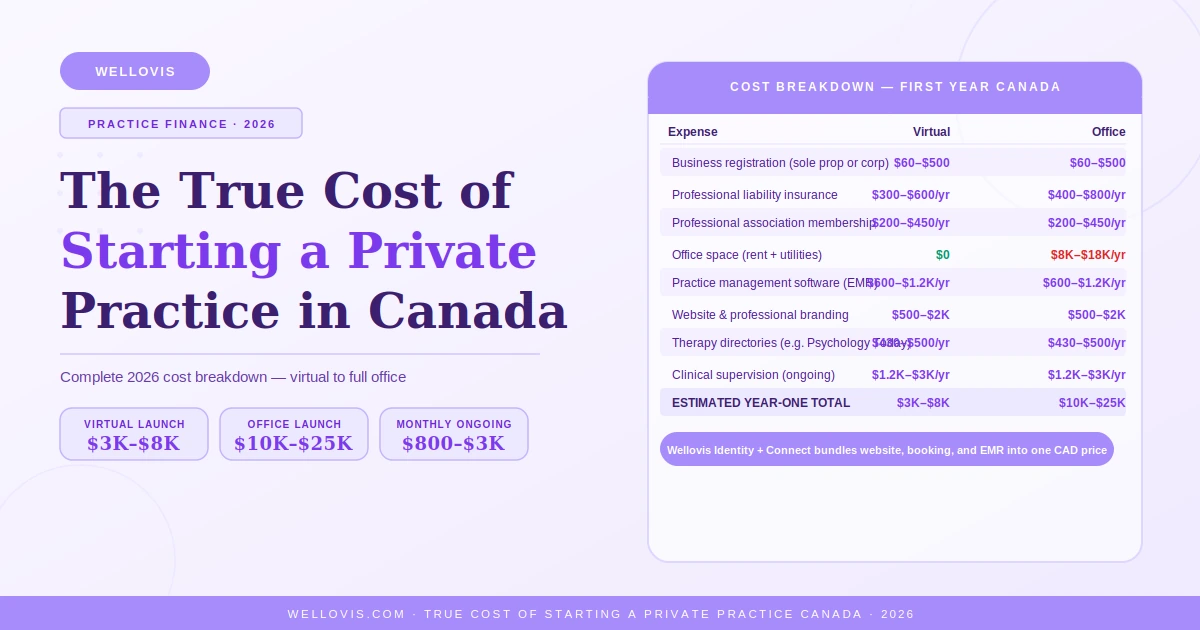
| Expense | Virtual Practice | Office Practice |
|---|---|---|
| Business registration | $60–$500 | $60–$500 |
| Professional liability insurance | $300–$600/yr | $400–$800/yr |
| Professional association membership | $200–$450/yr | $200–$450/yr |
| Office space | $0 | $8,000–$18,000/yr |
| Practice management (EMR) | $600–$1,200/yr | $600–$1,200/yr |
| Website and branding | $500–$2,000 | $500–$2,000 |
| Therapy directories | $430–$500/yr | $430–$500/yr |
| Clinical supervision | $1,200–$3,000/yr | $1,200–$3,000/yr |
| Continuing education | $500–$1,000/yr | $500–$1,000/yr |
| ESTIMATED YEAR-ONE TOTAL | $3,000–$8,000 | $10,000–$25,000+ |
💡 The biggest money-saving decision: Most new Canadian therapists should launch virtually. The $0 office rent vs $8,000–$18,000/year difference funds your runway, your professional development, and your marketing instead. Virtual-only practices also have a larger potential client pool — province-wide rather than city-specific. Many established practitioners who started virtual never felt the need to get a physical office.
How Many Clients Do You Need to Break Even?
This is the calculation every new therapist should do before they set their fees. Work backwards from your costs:
- Virtual practice monthly overhead: approximately $400–$700/month (EMR + directories + supervision + insurance pro-rated)
- Personal monthly expenses: will vary — let’s say $3,500 for this example
- Tax reserve (30% of gross): built into your fee calculation
- Total monthly need: $4,000–$4,200
- At $150/session with 30% tax reserve: effective take-home per session is approximately $105. You need approximately 38–40 sessions per month — roughly 10 clients per week — to cover everything comfortably.
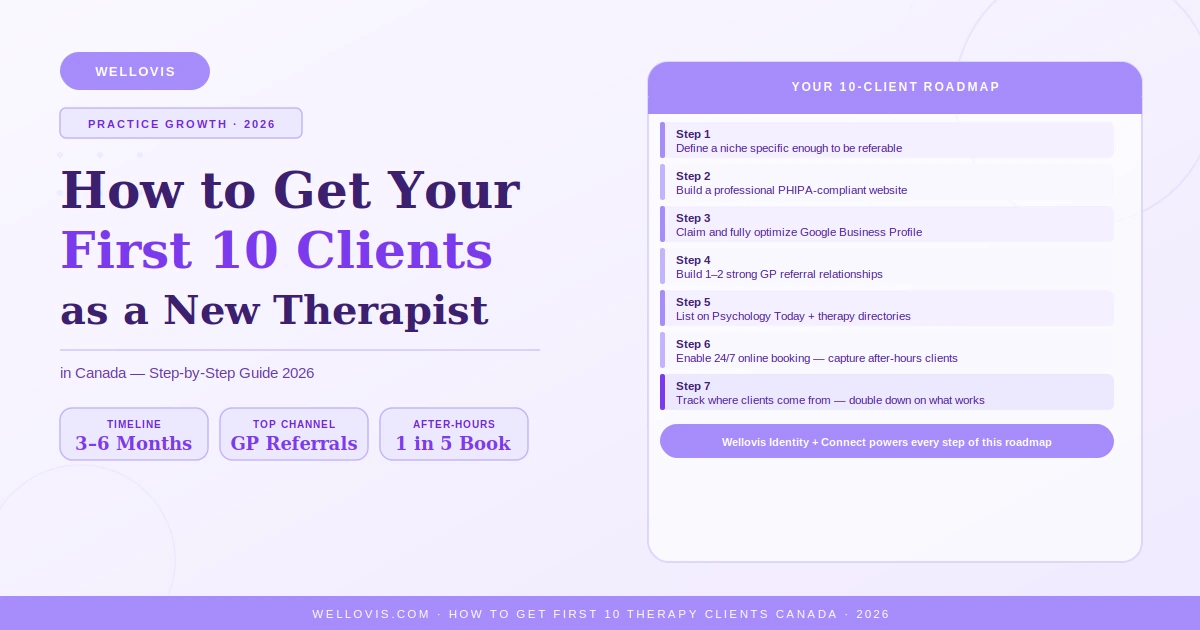
This is why most therapists start part-time alongside another income source, building their caseload before going full-time. For a guide on getting to that 10-client mark faster, read our guide on how to get your first 10 therapy clients in Canada.
Where Wellovis Reduces Your Startup Costs
One of the overlooked cost benefits of building your practice on Wellovis Connect is the number of separate subscriptions it replaces:
- EMR / practice management: included in Wellovis Connect — replaces Jane App, SimplePractice, OWL Practice
- Telehealth platform: included — replaces a separate PHIPA-compliant video subscription
- AI SOAP/DAP notes: included — replaces a separate AI documentation tool
- Online booking: included — replaces Calendly or Acuity
- Website and branding: included via Wellovis Identity — replaces a website designer, WordPress developer, and separate branding consultant
- Canadian insurance eClaims: included — replaces the $20/month Jane App add-on
For a new Canadian therapist piecing together tools from multiple vendors — an EMR here, a booking tool there, a video platform, a website designer — the combined monthly cost easily reaches $300–$500/month. Wellovis consolidates all of this into one transparent CAD subscription with no add-ons and no surprise fees.
📖 Related Reading
Frequently Asked Questions
How much does it cost to start a private therapy practice in Canada in 2026?
A virtual private practice costs approximately $3,000–$8,000 in year one, covering registration, insurance, association membership, EMR, website, and directories. A practice with a physical office adds $8,000–$18,000 in rent and related costs, bringing year-one total to $10,000–$25,000+. The biggest variable is office space — launching virtually is the most financially conservative approach for most new therapists.
What are the monthly costs of running a therapy practice in Canada?
Monthly overhead for a virtual therapy practice runs approximately $400–$700/month once established — covering your EMR subscription, therapy directory listings, supervision, and insurance pro-rated monthly. A practice with a physical office adds $800–$2,000/month in rent, bringing monthly overhead to $1,200–$2,700+. This doesn’t include your personal living expenses or the 25–30% of gross revenue you should reserve for income tax and CPP.
Should I incorporate or start as a sole proprietor?
Most new therapists start as sole proprietors — it’s simpler and cheaper to set up ($60 in Ontario for a business name registration). A professional corporation becomes financially advantageous once your practice generates $100,000+ annually, primarily through income-splitting and tax deferral opportunities. Consult a Canadian accountant who works with self-employed healthcare professionals to determine the right structure for your specific situation.
Do I need to charge GST/HST as a therapist in Canada?
Psychotherapy services provided by regulated health professionals are generally GST/HST exempt in Canada — meaning you don’t charge GST/HST on your therapy sessions and don’t need to register for a GST/HST account until your revenue exceeds $30,000/year from non-exempt services. However, the rules are nuanced and depend on your credential and province. Consult a Canadian tax professional to confirm your specific situation — this is not tax advice.
What is the cheapest way to start a private therapy practice in Canada?
Launch as a virtual-only practice (eliminating office rent entirely), register as a sole proprietor, use a platform like Wellovis Connect that bundles EMR, booking, telehealth, and AI notes into one CAD subscription, and build referral relationships with 1–2 GPs before spending money on paid advertising. This approach can get you to a viable caseload for under $5,000 in year-one costs.